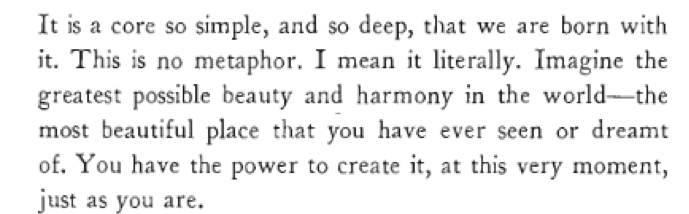
Every human being is a work of art. Within your heart, and within mine, are our true selves, an inner beauty, a sensitive poet. To demonstrate this unique identity, all you have to do is “be yourself.”
We dream of a world where all people are radically eloquent. Where removing the restrictions of social pressure, tradition, hidebound ritual, laws, institutions, causes mediocrity to evaporate, leaving only the brilliantly authentic. Prestige, popularity, status, face, propriety. That nonsense? Out! Out! Out!
If only. These protests [about constraints of ‘the system’] have about them an engaging period optimism, depending as they do upon the Rousseauean premise that most people, left to their own devices, think not in cliches but with originality and brilliance; that most individual voices, once heard, turn out to be voices of beauty and wisdom. [Joan Didion, Slouching Towards Bethlehem]
What happens when your true self turns out to be basic? Maybe just stop being basic? Just do what makes you happy and gives you meaning? But how do I know what this is? My motivations are unclear! How do I know that I really want to become a motorcycle engineer?
The easy answer is to look at my behaviour: because I quit my office job to become one. Actions speak louder than words, not merely to others but also to ourselves. I may say I want to be a screenwriter but if I take no steps to make this a reality can I blame others who doubt my intentions? Can I blame myself for doubting my passion? We can call this the James-Lange theory of identity: our actions precede our beliefs about ourselves rather than vice-versa.
The behaviour reveals the soul. But how clearly? Our behaviour is often overdetermined. Did you take up Rock Climbing because you “want to”, or was it because it looks good on Instagram, or because you want to impress your colleagues? If you never go alone, or unshared, an outsider could be forgiven for doubting your motives. So could you. But there are solutions: simply continue with the behaviour and, over time, your true motives should become clear. You still rock climb after your colleagues quit, or perhaps you gave up Instagram soon after. Purity restored.
What happens when your behaviour is permanently overdetermined? When there is no escape from confounding motivators? You become a teacher “to help people” (or was it because you had no other options?) You leave a stressful job because it is meaningless (or maybe you weren’t good enough?) You keep winning awards or unavoidable social prestige yet insist it has no bearing on your artistic passion? In this situation you are stuck, and either must react (gaining success to discard it; measuring your job performance to ignore it; disowning the prizes), or passively accept the outcome, trusting in your own self-assurance. Few can do the latter. Avoiding attachment – producing distance from accolades and other confounding symbols – is easier, and is one of Ocean Vuong’s recommendations to the young poet. If you accept prizes too frequently, too readily, not only will observers start to question the purity of your commitment to the craft, you too might start to think: “gee, I guess I must care some if I’m going to all these events when I could be writing.”
The James-Lange theory of identity is closely related to authenticity. How do we know a musician has “sold out” or if someone is a real “punk” (or “hippie”)? We know from their actions, the more distinct and unambiguous the better. The punk who wears a mohawk, leather jacket, and pierces their lips is not merely signalling to their community and the public that they are punk: they are signalling to themselves. Why else would they have done all this if they weren’t committed to being Punk? The James-Lange theory is thclosely related to cognitive dissonance: I claim I am Punk (A), but I also refuse to alter my behaviour in any major way (B). How do I resolve these tensions? Either (A) I give up being Punk (“I was never really a punk in the first place”), or (B) change my behaviour. Today, it is easier to do (A) than (B).
And showing you are a punk is relatively easy because of the convenient, narratively stable 'authorities' to rebel against. For the romantic liberal, what needs to be shown is rather more difficult. You are supposed to express your own preferences free from conformity or anxiety. The problem is that as the volume of people increases the field of expression is covered more completely. The total zone of being “basic”, or at least being a “type” has widened. This is the central theme of K-HOLE’s fourth report, Youth Mode:
It used to be possible to be special – to sustain unique difference through time, relative to a certain sense of audience. As long as you were different from the people around you, you were safe. But the Internet and globalization fucked this up for everyone…. The likelihood that you and Michelle Obama wish upon the same star is greater than ever.
How can you tell if you’re being your true self when it looks like you’re just following someone else’s path? You looked deep inside and decided your inner heart wanted to watch Disney films and travel to Japan? Something’s not adding up.
As the symbolic space is covered, the fringe of real radicalness (“I’ve Never Seen Anything Like That Before!”) has to become more extreme, more unambiguous to signal authenticity to the crowd and the self. This helps explain the strange depictions of ‘Free Individuals” in fiction. They are either absurdly ultra-specific and twee (Wes Anderson, New Girl, My Dinner with Andre), or are repeated enough times they become an overdetermining mode of life themselves. Your “authentic life” looks awfully like last month’s most popular Pinterest mood board. And even if you can find an ultra-specific niche, how many will be there to share it?
Individuality was once the path to personal freedom — a way to lead life on your own terms. But the terms keep getting more and more specific, making us more and more isolated.
I have seen various responses to this pressure. K-HOLE suggests some consumers now lean in to “post-authenticity” life, embracing the fully interchangeable aesthetic of Normcore. There is no ambition, the Normcore wearer does not attempt to be someone, but relaxes into being anyone. This is no solution to the Romantic liberal’s anxiety. The individual is hardly transcending social conditioning – they are cleaving, in fact, to the inevitability of being (some, but any) part of the masses. Then again, K-HOLE never pretended they had one. It is merely a consumer response to a tension in consumer identity-differentiation.
Another solution, identified by Gwern in the context of finding “success”, is to inhabit increasingly local corners of the internet. Liking Doctor Who is not very specific, nor even is liking Doctor Who and Supernatural, but once we add in another circle to the Venn diagram, “Superwholock”, we start to get somewhere. Gwern gives tangible examples like Wikipedia editing, speedrunning obscure games, or discussing niche anime. Your identity-defining interest is ultra-specific and thus differentiates you from others. Equally, it is unlike the lone stamp collector in the shed: you can also be a ‘someone’ in a community (“I’m number three at Wii Golf speedrunning”) thanks to the assortive effects of the Internet.
This is closer, I believe, to the Romantic liberal’s fantasy. There is an endless stream of this material on Tumblr and Instagram. Working dogs wish they could run free like ‘a truly happy dog’; historical figures are irrepressibly zany and our school history conspires to hide this from us; random people in the anecdotal backdrop of “the other day”, will come up with obscure wisdom or amazing off-the-wall articulate brilliance at any moment The internet becomes a monument to the individuality of the human race.
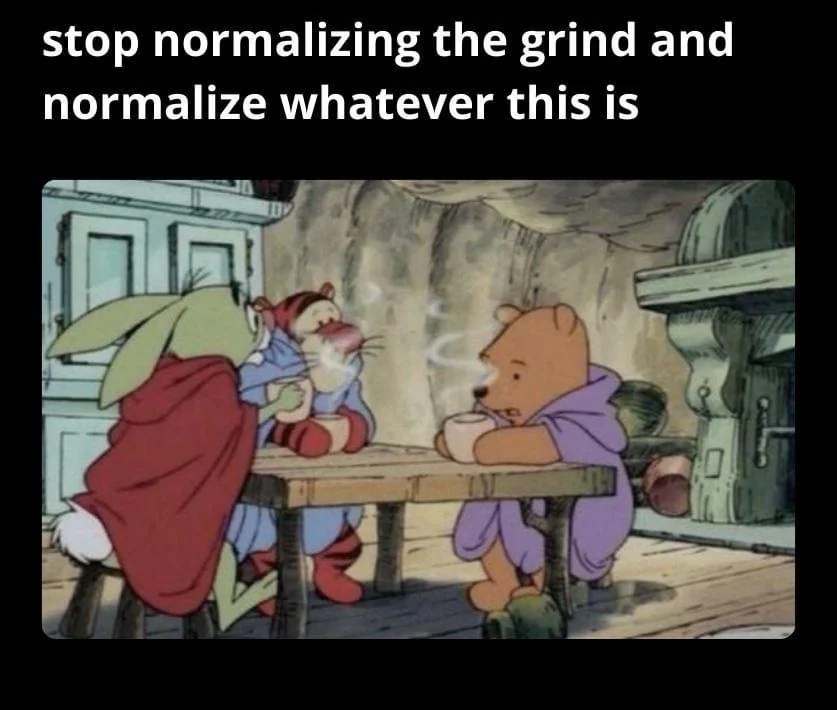
Exactly how it all fits together is for the reader to decide. It is not possible to run through the fields of Kazakhstan forever or to subsist in a cottage in an undefined country with no job. At some point the travel ad ends and real life begins. And that real life probably will, in its routines, activities, aesthetics, and so on, resemble the lives of other people quite closely. In many cases, these aesthetics will disappoint. Not merely because they are duplicates (“you are living out another’s fantasy"), but because they go against the very idea of freedom. Really, you’re going back to living as a stay at home mother? You want to be a highly successful corporate drone? This is the disappointment of raising a child to be a seafaring adventurer only for her to choose to become a McKinsey consultant.
I am not claiming radical individuals, or even moderately unconventional individuals, are fantasies. They clearly do exist. Nor am I suggesting that everyday people are incapable of individuality, or producing beauty, or unexpected, timeless moments of human connection. All I am suggesting is that most people more or less copy others when deciding their lifestyle, job, dreams, and so on; that this is not evidence of their defectiveness, of their ‘enslaved minds’, their false consciousness, or their normie upbringing. That it is okay to copy others sometimes, even to copy others most of the time. To expect every person to eventually demonstrate a radical ingenuity, an untamed, beautiful uniqueness, when “freed” is not necessarily the release you think it is:
Lol can some of the people in here stop making us average people feel bad? I’m honestly mentally exhausted by wishing to be this and that and berating myself for not really being passionate/motivated about anything other than philosophy, psychology, books, my religion, and cute but simple things. Sure maybe I make a boring friend and boring future spouse and I have less stories to tell but I just wanna be someone with lots of inner beauty at the end of the day even though there are extremely skilled people with lots of inner beauty. I’m aware of that. I just wish that didn’t mean I’m not someone worth knowing [Random Youtube comment]